Seventeen destinations · four drawersEvery page belongs to the same universe.
Case File Alexandria · 415 A.D.
The Case of Hypatia of Alexandria
According to legend, Hypatia of Alexandria was brutally murdered in the year 415 A.D.. Notably, there were no eye-witnesses on record nor was there a corpus delicti nor was there any official inquiry or investigation into the supposed homicide. By modern standards this presumptive crime remains unsolved because it is based solely upon hearsay and rumor well after the putative event. Everything about Hypatia’s death, whether in 415 A.D. or any other time, is a mystery. Her alleged murder therefore calls for some forensic analysis to her case.
Eye-witnessesNone on recordCorpus delictiNoneOfficial inquiryNoneCase statusUnsolved
01 Opening Statement
Legend enters the evidence room.
Forensic science, or just forensics, typically involves many other sciences, such as biology, geology, botany, chemistry, physics and others in the performance of its reconstructions. Historical science, a branch of forensics, generally is much more limited in scope, relying mainly upon partial or intact human records. Most often these take the form of official documents, authored works, biographical writings, autobiographical writings and material artifacts. In this study, we shall consider both written and pictorial representations of Hypatia to determine what they may reveal about the woman behind the legend, as well as about the claims later generations and societies have upon her. Written references are drawn primarily from the definitive study done by Maria Dzielska on sources informing our knowledge of Hypatia. As there are no pictorial records of Hypatia, representations of Hypatia are drawn from artists’ conjecture.
We begin with a description of the popular legend come down to us over 1,600 years. For this we turn to the source favored by students and others looking for a quick information fix, i.e., Wikipedia. Accordingly, “Hypatia, born c. 350–370; died 415 AD often called Hypatia of Alexandria, was a Greek mathematician, astronomer, inventor, and philosopher in Egypt, then a part of the Eastern Roman Empire. She was the head of the Neoplatonic school at Alexandria, where she taught philosophy and astronomy."
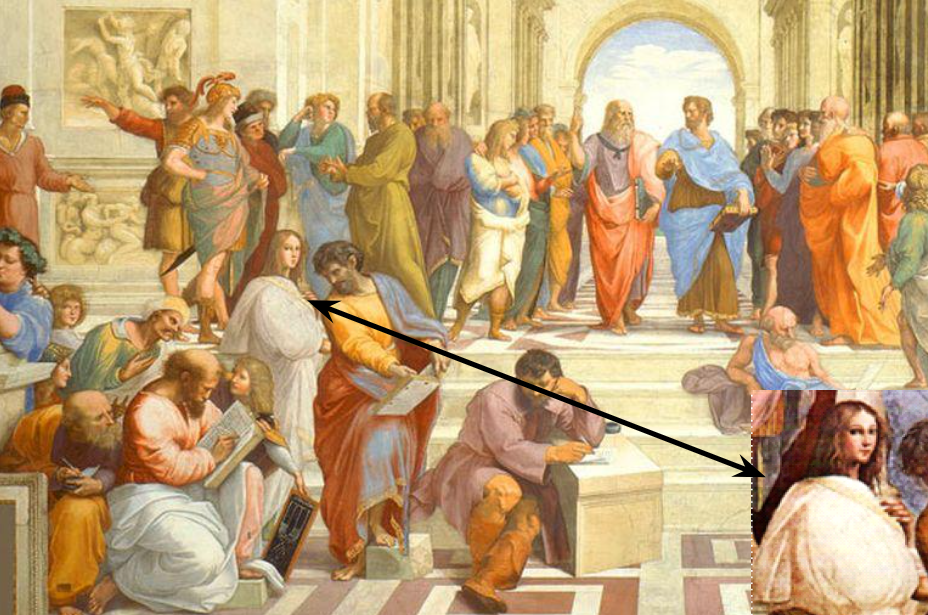
Figure 1 -- Raphael, School of Athens – detail is an assumed portrait of Raphael's lover Fornarina, once thought to represent Hypatia. [Inset and graphic added.]
"A pagan, Hypatia was murdered by a Christian mob known as the Parabalani after being accused of exacerbating a conflict between two prominent figures in Alexandria: the Prefect, Orestes, and the bishop, Cyril of Alexandria.”
The past to which Hypatia of Alexandria belongs, i.e., the 4th and 5th centuries of the Roman Empire of Late Antiquity, is to us today a foreign country. We may study written languages and other artifacts from that period, but not living it we remain tourists in a foreign land. Like all sightseers our assessment of long bygone times and places is often subject to our own beliefs and ignorance. The Wikipedia description above is, in fact, rife with both our modern beliefs and ignorance. For instance, the first thing to notice is the uncertainty about Hypatia’s year of birth. Until fairly recently the year 370 had been canonical, though no official birth record supported this. Belief in this date allowed historians and artists to portray her as young and beautiful at the time of her conjectured death. Given the lack of any reference, official or otherwise, to her time of birth, imagination and bias filled in to make youth and beauty a part of her story.
02 Constructing an Icon
A portrait painted by later centuries.
Hypatia, as popularly conceived, may be likened to a celebrity figure in a Madame Tussauds Museum diorama. Five hundred years ago, the painter Raphael did not intend the person highlighted in Figure 1 to represent Hypatia of Alexandria, rather it is likely a portrait of one of the artist’s lovers. Modern eyes however made a connection with Hypatia because the painting encapsulates aspects of her legend perfectly. We see the character placed among notable philosophers, scientists and luminaries associated with the ancient School of Athens, with Plato and Aristotle figured prominently. This reinforces Hypatia’s reputation as a Neo-Platonist philosopher. Perhaps more importantly it provides pictorial “proof” she was young, beautiful, and of Greek, hence European, extraction.
The pure white robe or toga in turn became symbolic of her assumed virginal purity, also part of her legend. The image of Hypatia as a young, beautiful, Greek virgin with a superior intellect and forceful personality really did not gel until the 18th century. Only then was it conveniently projected upon Raphael’s work completed 200 years earlier. Apparently those who saw Hypatia in this painting were unbothered by the fact it was produced over 1,000 years after her disappearance from the historical record. The picture is still used to this day as a touchstone to Hypatia, despite our knowing the framed figure is not Hypatia.
Also, it was during this period of the European Enlightenment her story took on its decidedly anti-clerical bent. Toland, Voltaire, Gibbon and others declared Hypatia had been a victim of religious persecution and superstition. Later authors and artists, longing for a presumed Golden Age of ancient Greece, rhapsodized over this woman having “the spirit of Plato and the body of Aphrodite.” By such a description, her alleged murder transforms her legend into a crime against both free thinking and sexuality. These notions are reflected in other art of the time.
Figure 2 –Mort de la Philosophe Hypatie. A Alexandrie.Artist’s conjecture
This picture by Louis Figuier shows a central Pharisee-like figure directing black slaves to take Hypatia to a place of execution, while one impatient member of the crowd already is in the act of stoning her. The setting is a mish-mash of Egyptian and Greek architecture, including faux hieroglyphics on a backdrop wall and is laden with social assumptions of its time.
03 Retelling the Story
Martyr. Feminist. Film character.
In Figure 3 C.W. Mitchell imagines a tall, shapely Hypatia stripped of her clothing but having sufficient time to stand before her assailants to make some declamation, perhaps on what a glory it is to be a martyr for reason and enlightenment against the forces of ignorance and darkness, i.e., the Catholic Church. Later, in the second half of the 19th century, scholars promoted the idea of Hypatia more as a scientist and mathematician than a philosopher, as well as a feminist. This fit nicely with the progressive trope which cited Hypatia’s death as the death of reason at the hands of religious fanatics and the start of the Dark Ages, lasting until the European Enlightenment and the rebirth of science.
Figure 3 – Hypatia – Death Scene.
Figure 4 – Hypatia’s table setting in Judy Chicago installation
These few references from the last few centuries typify the story told of Hypatia over and over and over again, ultimately resulting in the Wikipedian summary cited earlier, as well as Judy Chicago’s reverential inclusion in her “dinner party installation” (Figure 4) for a panoply of historical feminists.
More recently, the 2009 film “Agora” (Figure 5), starring Rachel Weisz and produced by Mod Producciones -- which grossed an estimated $70MM worldwide -- took further liberties with the legend. It would be not at all unlikely if these embellishments take root and establish themselves within the popular imagination.
Figure 5 – 2009 film starring Rachel Weisz added to Hypatia story.
04 The Surviving Record
Who actually left a record?
Prior to the Judy Chicago and Rachel Weisz productions there had been other stage productions using Hypatia to make one point or another. Also, there was a famous Theosophist by the name of Annie Besant who claimed to be the reincarnation of Hypatia of Alexandria. [See Figure 6.] Ms. Besant penned a children’s morality story concerning Hypatia’s alleged martyrdom. Interestingly, the details of her past life account exactly mirror the popular legend already well established .
Figure 6 – Annie Besant, Theosophist.
Figure 7 – Text from the Suda.
Clearly, Hypatia of Alexandria has enjoyed immense post-humus notoriety and commercialization. We need to keep in mind though that neither her birth nor her death – nor much else -- are indisputably documented. The fact is Hypatia was virtually forgotten for over 800 years until resurrected in the 18th century as fodder for certain ideological dogmas. Around this time various ancient sources came to light, such as the 10th century Suda, an anonymously produced encyclopedia.
This compendium incorporated fragments about Hypatia of Alexandria from earlier writings of the mid-5th century and later. While the authors of such works, e.g., Socrates Scholasticus (a Church historian writing around 440 A.D.), Damascius (a pagan apologist of the 6th century), and John of Nikiu (an Egyptian Coptic bishop around 680 A.D.), were closer to Hypatia’s time, they were not contemporaries and did not possess personal knowledge of or acquaintance with her. In fact, John of Nikiu says of Hypatia “she was devoted at all times to magic, astrolabes and instruments of music, and she beguiled many people through satanic wiles.” Most later historians have consigned Bishop John’s assessment to ignorance and bias, while finding other accounts more to their liking.
One personal acquaintance
Synesius of Cyrene
Whether one accepts or rejects these earlier accounts of Hypatia’s life and death, there remains one source who personally knew Hypatia. This is Synesius of Cyrene, who is reported to have studied philosophy with her in the early 390s. Synesius, who became a bishop of the Catholic Church in his later years, was a prolific writer. [See Figure 8 sample.] Thus, historians have access to speeches, essays, hymns, homilies, and 159 letters from his personal archive. Six of the letters are addressed to Hypatia, so we would expect these to give definitive information about her life, though not her means of death because Synesius died in 414, the year prior to Hypatia’s supposed murder.
Figure 8 – Sample of Synesius’ writings.
05 Testing the Evidence
Letters sent. Replies missing.
There is one problem however with Synesius’ letters to Hypatia. While his files contained his letters addressed to her, there are no originals or copies of any replies she might have made to him. Given his borderline worship of his former teacher, one would expect he would have cherished such replies and stored them safely for posterity. In my research on Hypatia the matter of her replies never seems to have been addressed previously by scholars. I found this intriguing, so contacted several academic specialists directly to learn their thoughts on the matter. I learned from these scholars that it was common for writers in those times to keep copies of their epistles, along with replies to them. This is not unlike our own time with the saving of email correspondence in Sent and Saved file folders on our computers. I also learned that often a person might not send a letter directly to its intended addressee but to others as a means of influencing public opinion or generating controversy behind the addressee’s back. Typically, this might be done as rhetorical refutation of an addressee’s arguments or religious positions, not unlike taking out a full-page ad in The New York Times today. Thus, we will never know if Synesius’ letters were received by Hypatia, much less delivered from his hands. Perhaps more mysterious is why no letters written by Hypatia to Synesius or any other person have been discovered either in their archives.
Also, why did such a well-known figure as Hypatia not leave an archive of her own? An archive preserving not only letters – but also original philosophical, scientific and mathematical tracts and treatises? Up to this point we have looked at the myth of Hypatia of Alexandria, including what she is thought to have looked like, what her accomplishments were, and how she died. The further away in time we get from her, the more her story sounds like a fairy tale or an allegory. Digging deeper into the historical record, we perhaps get closer to the real Hypatia; however, the extant record is sketchy, ambiguous and controvertible, at best. In fairness, a few mathematical commentaries either edited or co-authored by her have been preserved either directly or incorporated into the works of others. There is evidence she contributed to some later additions of math and astronomy texts written by her father, Theon; as well as having herself written commentaries on the works of earlier scholars.
The bottom line is there is no evidence for, and no serious academics suggest, Hypatia made any original contributions to mathematics or any other field. Additionally, claims Hypatia was an inventor do not stand up to scrutiny. It is said she invented the astrolabe, however the device was first invented about 500 years earlier. This misattribution comes from a letter of Synesius in which he confused the astrolabe possibly with a hydrometer, which also was in existence already. Perhaps we can say with at least some certainty about Hypatia is that she appeared to be extremely competent in her field and may be rightly considered a leading teacher of her time. This statement does nothing to solve the mystery of her death however.
Why would anyone want to brutally murder a teacher? Because she was a pagan? There really is no evidence for this and there are some historians who assert she actually may have been Christian. Besides, there were plenty of other pagans of standing living in Alexandria who were not killed. Was she killed for teaching Neo-Platonism, as a kind of encore to the execution of Socrates some 800 years earlier? But many educated Christians also considered themselves Neo-Platonists. In fact, Synesius when he became a bishop insisted on his right to adhere to this philosophy. If not for paganism or Neo-Platonism, the chief remaining motive for knocking off a public figure such as Hypatia might be political. It is true there was political strife at the time between the Roman prefect Orestes and the Bishop of Alexandria, Cyril.
The story goes that Cyril believed Hypatia had undue influence over the prefect and may have directed his Church goons to get her out of the way. Given that Orestes seems to have disappeared from the historical record coincident with Hypatia’s disappearance, it would seem murder would have been unnecessary, even if to send a message to Orestes. Where does this leave us? Remember: there were no eye-witnesses accounts of Hypatia’s assassination; there was no corpse to be examined; and there was no official inquiry or investigation into the alleged homicide. Everything seems to have been handled quietly, including the removal of the prefect Orestes. Like so much having to do with Hypatia’s life, we are left in the dark, holding in our hands little more than a crude hagiographic icon.
As has been shown, this has been sufficient for building the myth of a universal genius of antiquity who became the unwitting martyr to science. Hypatia’s legend may well survive for another 1,600 years, growing and morphing over time. In fact, it has been suggested she was not Greek at all, but African; thus, she died not only for being a brilliant pagan but an Egypto-Pagan steeped in alchemy and magic as much as science and mathematics.
06 Competing Portrayals
Who gets to claim Hypatia?
Increasingly, with Diversity as the latest cultural clarion call, we see old Euro-centric images of Hypatia being replaced by Egyptian portrayals borrowed from funerary portraiture of Late Antiquity in the Fayum, such as seen in Figure 9
Figure 9 – Romanized Egyptian mummy portrait, c. 25 A.D.
Following Martin Bernal’s thesis of the “Black Athena” and the Afro-Asiatic roots of classical civilization, some venture further south into Africa, offering images for a Black Hypatia like Figure 10.
Figure 10 – By dabrand onsphere, appearing on Deviant Art.
As Hypatia of Alexandria’s legend grows, she speaks for more and more people who wish to lay claim to what she has come to symbolize. As such, we likely never will be able to say of her:
CASE CLOSED
Paper presented at the 2018 Hawaii International Conference on Arts & Humanities.
Next Continue the Investigation
Enter the novels.
You’ve heard of her but who was she really?
Find out the untold story of Hypatia of Alexandria as told by her own hand.
Wind Rose is a reimagined and expanded version of The Alexandria Scrolls, blending elements from the author’s award-winning screenplay into a cinematic, fast-moving narrative. After his parents’ mysterious plane crash in the Timor Sea, Brandon Blake is drawn into a mind-altering spiritual journey that begins with hypno-regression and unfolds across past lives, ancient mysteries, and hidden realms. As a relic hunter navigating encounters with mythical forces and unexplained phenomena, he must rely on intuition, divination, and emerging psychic abilities to uncover the truth. Ultimately, his journey becomes a search not just for answers, but for purpose, love, and the direction his life is meant to take.
The Wind Rose Conspiracy: The Many Lives of Brando ....